|
 |


The gorge of Aggitis
We thank our friend Christos Tsifoutis for the material and the photoes
 |
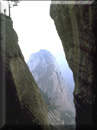
It is an epigene gorge of the river Aggitis, of a length of some 15km, originated by the evolutionary changes at the basins of Serres and Drama, between the mounts Pangeo and Menikio. It is a deep and narrow riparian gorge between rough rocks (that is the definition of the epigene gorge) owing to the renewing action ofthe river. The Aggitis river gorge that has been formed in four evolutionary stages during the neogene and the quartenary period is known as "Stena Petras" or "Dioriga". |
|
The rude sides of the gorge were considered to be a man-made construction by the Macedonians under Philip II, in their attempt to dessicate the swamps of Filippi and Drama. The ravine is a dumping caused by deep ruptures that broke into pieces the marble base and by the parts that have sat upon it. These ruptures start from the village Symvoli and reach the village Lefkothea. This epigene Aggitis river gorge created culminating sides due to their "sudden fall" that resulted in the creation of vertical marble slopes of a height of 50-70m. The course of the river in the ravine is not a straight one but it forms " meanders " , a characteristic of many rivers in Greece, according to which the river in some points carves the rocks while in others it creates depositions. |
|
Aggitis river throughout its course In "time" and in "space" has created many fullydecorated "caves" and "arches". The region has been often inhabited in the past either because of the abundance of food and water or because man was persecuted by his various ennemies. The presence of humans in the region since a long time ago can be also seen on their "rock paintings". According to an article in the magazine of the Museum of Natural History of Vienna published by Charles Meis, Robert Zeeman and Nikolaos Symeonidis in February 1978, in three places there have been found "rockpaintings" representing animals (deers with horns,camels, horsemen keeping the reins of horses and darts) or other abstract designs From the painting of the riders it is estimated that the rockpaintings were produced in the fifthsixth centuries A.C. |
|
The flora of the valley includes all the species of the wild acquatic laurel, willow trees, planetrees, splinters, wild poplars, while the fauna is rich is wild species too as plain partridges, rock partridges, wild fauna is rich is wild species too as plain partridges, rock partridges, wild pigeons , turtledoves ,blackbirds and woodrocks. On the rocks of the ravine rapacious birds are nesting like hawks, (falcons tinnunculus) etc. Some inhabitants of the region said they have also seen snake-eagles (circaetus). One can reach the ravine either from its starting point at the village Symvoli or from its end at the village Lefkothea. Given that one of the goals of the SelfGovernment of Serres is to construct a passage connecting the Alistrati cave to the ravine, together with walk paths along the river, bridges, kiosques and refreshment stands and keeping in mind that the violent waters of the river may be used for canoeing, the ravine of Aggitis river is undoubtfully a terrestrial paradise. |
© Copyright Oreivatein 1997-2017 - All rights reserved