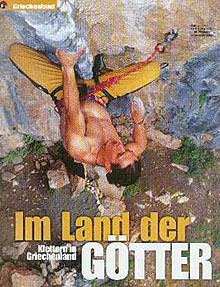
 Despite Greece being known the world over for its seas and beaches, the country could just as well be characterised as the "country of mountains" since the majority of it is covered by rough mountains. This enchanting mountainous terrain offers a different perspective on our country. Wild mountains, rich in contrasts, legends, traditions, impressive peaks and slopes - a wealth of stimulating elements for mountaineers and, more generally, lovers of nature. Mountaineering in Greece began, essentially, on 2 August 1913 with the first ascent of the highest peak in the country, Mytikas (2,917m), on Olympus by the Swiss climbers Fred Boissonnas and Daniel Baud Bovy with a guide from Litohoro Christos Kakalos, a violinist and hunter of wild goats on Olympus. The first rock climbing routes were put up in 1934 (again on Olympus) by the "artist of the rocks", the famous Italian rock climber Emilio Comici together with his partner Anna Escher. In the decades of the 50's and the 60's the most prominent figure on the Greek climbing scene was George Michalidis, who scoured the Greek mountains and put up some of the greatest classic routes here. The most important route he put up is on Giona (2510m), a 1200m long route of the sixth grade of difficulty, which will be described later. From the decade of the 70's Greek climbers began to visit the Alps regularly in the summer and the level of climbing here began to rise. However, the revolution began in 1985. From then on climbing schools took place regularly and there has been a remarkable rise in the numbers of people taking up climbing as there has been in the grade of difficulty being climbed. The number of climbers today in Greece can be put at around 2-3,000 people. Despite the small number of climbers in relation to other European countries the number of important ascents being done both at home and abroad is not unremarkable. The majority of climbers live in Athens where there is a hard core who are interested in traditional climbing and Alpinism. The most important routes in the Alps have been climbed by Greeks, while on the Greek mountains long and difficult routes have been put up both in summer and winter conditions. There are around 30-35 Greek mountain guides, most of whom rely upon a second main profession. Their association was set up in 1994 and is in the process of being recognised by the UIAGM. There is also a strong sport climbing movement with important centres in Thessaloniki, Trikala and above all in Patras where there are climbers climbing F 8b/c (Giannis Torelis, Aris Thanopoulos, Giannis Potamousis). ASTRAKA The mountain Gamila (2,497m), which is one of the most beautiful in Greece, lies in the north of the country. The mountain is bordered by the two deep gorges through which run the rivers of Voidomatis and Aoos, and the area has been declared a national park. On the impressive northern slope of the second highest peak on the mountain, Astraka (2,436m), are found two of the great classic routes in the country. How to get there The approach to Astraka begins from a beautiful traditional village, Papingo (70km from Ioannina). From Little Papingo a marked path leads in 3-3.5hrs to the refuge at 1950m to be found on a beautiful col at the foot of the crag. The refuge is being improved continuously and is staffed during the summer. Accommodation You can stay at the refuge or camp just behind it or a little further away and on lower ground in the area known as Laka Tsoumani where there is a spring close to the crag of Astraka at the spot where the footpath for Gamila begins. Along the path for the refuge there are four springs, the last one 20mins before the refuge. Maps "ZAGORI" (1: 50.000) Anavasi editions 2000 "Epiros - Thessaly", (1.250.000) Road Editions Useful telephone numbers Refuge warden 0932 982464 The Christodoulou Inn- Papingo village- (also for refuge bookings) 0653 41115 / 41138 Zeus Inn -Papingo village- 0653 41257/41892 Recommendable routes 1. "Kopsi ton Triestinon" (The Trieste's climbers Edge) First ascent: V. Zecchini - S. Delaporta-Xidias 1965 Orientation: north Difficulty: ED- (VI) Height difference: 400m Length: 500m. Time: climbing only 5-7 hrs. Total: 7-10 hrs Rock quality: mediocre to good. In a few spots it is loose In situ gear: a few rusty pitons Set off from: the Astraka refuge How to get there From the refuge ascend the ridge towards Astraka. Just before the rocks traverse right at the base of the slope. Having passed the "Schisma" (huge chimney) cross the scree. You arrive at the foot of the route in 15-20mins. Return From the peak the descent heads down right (south-west). Relatively easy climbing down the gully leads to the refuge in an hour. Comments The climbers from Trieste have left us a valuable heritage. The route has acquired mythic status for older climbers. Despite its relatively easy grade of difficulty there are few repeat ascents every year (5-6) keeping the prestige of the route intact. It was no chance occurrence that it took 15 years before the first repeat ascent took place in August '81. Today the Trieste route constitutes a "must" for each new climber in Greece. When to climb July - August Equipment general (for repeating the routes) Nuts, friends, slings, 10-12 runners (quick draws), 3-4 karabiners, double 50m ropes, and a helmet. A hammer and pitons are optional. 2. "I Kopsi ton Hamenon Sintrofon"(The lost partner's Edge) First ascent: A. Theodoropoulos, D. Sotirakis Date: 26-27/9/1987 Difficulty: ED+ (VII-) Height difference: 400m Length: 600m Time: climbing only 5-7hrs, total 7-10 hrs Rock quality: mediocre to good. In spots it is very loose. Permanent protection: a few rusty pitons. Set off from: the refuge. How to get there: From the refuge ascend the ridge towards Astraka. Just before the rocks, traverse left, continuing in that direction across the foot of the slope crossing both the Triestinon route and the Schisma (huge chimney). You reach the base of the route in 15 mins. Return As for the Triestinon route. When to climb July-August Equipment general (for repeating the routes) Helmet, nuts, friends. Hammer and pitons optional. Comments The route follows the characteristic vertical ridge to the right of Schisma (huge chimney). The location of the route in the centre of the crag, its direct route, the continuous sense of the vertical, the overhanging cruxes, the variety and beauty of the moves, the changing view, the alpine setting, the alternations in the quality of the rock from excellent to loose, and finally - something rare in this country - the sense of a big alpine route all add to the great aesthetic quality of the route. VARASOVA Not far away from the estuary of river Evinos, the dominating Varasova rocks emerge right where the peaceful valley of Etoliko meets the sea. The beauty of the scenery, the exceptional solidity of the rock, easy access and the the extra pleasures offered by the sea were the obvious advantages which have established Varasova as one of the most important climbing areas in Greece. Varasova, a limestone massif near the sea, just opposite Patras, has a height of 917 m. There are three summits of almost the same altitude. Varasova flanks drop abruptly into the sea on the south and Southwest and this is the location of the most important walls, just between Vasiliki and Galatas villages. The limestone cliffs of Varasova have earned a good reputation due to the soundness of the rock. "Hidden" holds and secure nut placements make climbing in Varasova particularly enjoyable. Varasova has about 100 routes, most of them multi-pitch, from 100 -200m. Maps, Guides "Varasova Rock climbing guide" by Aris Theodoropoulos available from ALPINE CLUB OF AHARNES, 126 Filadelfias St., AHARNES, GREECE, tel. 2461528, Fax: 2469777 Central Greece, Road editions "SENTERO LUMINOSO" (Luminous Path) Luminous Path is one of the most serious big routes in Greece, with limited repeat ascents. Difficulty: VII+ (VIII) 600m First ascent: - A. Theodoropoulos, G. Voutiropoulos, Th. Mihailidis,. 24. 5. 96 In situ belays: Anchors at all the belay stations with 5 or 6 bolts on each rope length. Useful gear: Stoppers, friends (1,5- 3,5), 12 quick-draws, must have 50 m ropes. Comments: One of the most serious routes in Greece. 600m of hard and impressive climbing. It is a route, which heralds a new generation of routes in this country: big routes with a sustained high level of difficulty, demanding the placement of traditional protection without being characterisable as a dangerous route. Ascents take about 10-14hrs for climbers in good form. How to get there: Follow the footpath leading towards the summit. In 30mins you will be at the base of the route. Return :2 hrs along the rough summit footpath. (There is also the possibility of descending by abseil: upper section (II) 8 abseils, lower section (I) 6 abseils.) When to climb: A long day is needed but it needs to be a day without strong sunshine or a high temperature. A cloudy day in May would be ideal. Tip: At the summit there is a well with water! Useful telephone numbers: Bratsos Tavern (Krioneri) 0631/41225,41125 Rooms to let (Krioneri) 0631/ MOURKOS MOTEL 41216, 39214 Mt GIONA 2510m The northern face of Mt Giona consists of groups of vertical tock faces. The most impressive one is Plaka Sikias, the largest climbing face in Greece, with a height of 1200m. Plaka Sikias situated in central Greece, above the picturesque village of Sikia. Plaka Sykias has been a favourite among Greek climbers since 1954 and still is a ground for Greek climbers to test their skills to the limits, on the long mountain climbing. Approach: From the village of Sikia take the marked path to Lazorema, which begins opposite the basketball court. At the place "Despoti Varka" the path crosses the streambed of a torrent from Plaka. Leave the path at this point; follow the left bank of the stream a short distance before crossing to the right and starting approach to the vertical rock face. Climb higher to a distinctive ledge, which easily brings one 50 meters higher than the foot of the cliff. This is in order to avoid the loose rocks and often wet and slippery slabs at the foot of the streambed. In the left section of the ledge beneath the cliff begin the routes "Chloe", " Diagonal" (Dhiaginios) and others. For the "Michailidis" route, climb to the left on easy rocks (I pitch) until a second ledge with distinctive tree, where the climb begins. Total duration of the approach from Sikia is 2 hours. Rock: The rock is generally good, compact limestone, but loose rocks are not uncommon. Useful equipment: 12 quick-draws, slings, nuts and friends, double ropes of 50m. Season: The ideal season is the end of May to mid- October. Avoid hot summer days as the routes begin at height barely 1200m. and the rock face radiates the heat. Sikia village: Huddled at the foot of the huge 1200m-cliff face, is the small village of Sikia, home to the shepherds of Giona Mountain. Works are already in progress to accommodate climbers (the old primary school is being converted into a hostel, a private hostel is under construction), One can always set-up camp in either of the two pretty meadows, directly after the irrigation canal, 10 min. out of the village, on the path to Lazorema. If you intend to climb all of plaka to the summit, it is best arrive in the evening and sleep in a distinctive cave to the right of the ledge, a little before the start of the routes. Sport climbing at Sikia: Around 75 new routes10-45m long have been equipped with stainless steel bolts in crags around the village. Sectors (in UIAA scale) 1. Spilies (18 routes, 20-25m, V - VII+) 2. Chamilo lithari (8 routes, 20-45m, double ropes! IV - VI+) 3. Rakospilies (35 routes, 20-25m, V - VII-) 4. Zoodochos church (9 routes, 10-40m, double ropes! V - VI+) 5. Baby (4 routes, 10m, V - V+) Maps, Guides Central Greece, Road editions "Mt Giona" (1: 50.000) Anavasi editions 2000. Routes 1. "Michailidis". ED- 1.200m. Comments: This was the first ascent of Plaka and become a legend in Greek mountaineering circles. First climbed - after three attempts- by the foremost Greek climber George Michailidis and L. Leontiadis back in 1959. Plaka itself (the fist part of the route, until the wide ledge) has a difficulty of ED and height difference of 300m. Follows the very long, but far easier, section from the ledge to the ridgeline (D, 850m). "The classic route"! Tip: Possibilities for a bivy on ledges with trees. Time: climbing the entire route 10-14 hrs. Total: 20 -22 hrs Descent:: by abseil from the same route and "Chloe". From the ridgeline walk E to the peak of Pyramida and follow the marked path to Lazorema and Sykia. (4-5hrs) 2. "Dhiagonios" (Diagonal). ED (VI+) 280m. (A. Theodoropoulos D. Bourazanis 1993). Comments: Begins in the centre of Plaka cliff and crosses the entire vertical rock face diagonally. Particularly interesting third pitch. The "key" to the route is the impressive crack with which one comes out of the huge corner of Plaka (overhanging above and below the crack). Return: by abseil from "Michailidis" and "Chloe". 3. "Chloe" ED (VII+) 200m. First ascent: I Aliyiannis, D. Stravogenis, D. Hatzi 1990. Comments: A modern classic. The best rock face in Plaka. Well protected by bolts. Descent: By abseil on the same route. 4. "Chloe direct" ED+ (VII) 110m. First ascent: B. Tsoupras, Th. Papagiannis1995 Comments: The natural continuation of "Chloe", however, totally different in character. An adventurus route, with a little permanent protection. Descent: By abseil from the ledge, or the last 3 pitches of "Michailidis" and "Chloe". 5. "Ton Esthiseon" ED+ (VII+) 250m. (Total length 345m) First ascent: Ch. Kouniakis, D Titopoulos 1991. Comments: A pretty but demanding route, mainly along the smooth slabs. After the first two pitches, which are the same as those of "Chloe", it continues to the left. Attention: at this point begins one new direct, uncompleted for the moment line. Descent: By abseil from the ledge, or the last 3 pitches of "Michailidis" and "Chloe". |
© Copyright Aris Theodoropoulos 1997-2017 - All rights reserved